

Adapted Book Type 1: Emergent Book Share
Designed for early book users and emergent communicators, these books facilitate interactions through simple stories. Interactive “reveal” panels are created as velcro lift-off flaps to provide anticipation and tactile feedback. Books include introductory AAC (Alternative & Augmentative Communication) cards which can be used to teach book operation and introduce core vocabulary.
Adapted Book Type 2: Early Language
These books support vocabulary development, early language modelling, and confidence-building in communication. Learners are invited to choose picture words to actively participate in simple storytelling. Picture-word communication cards are included for modelling language using simple AAC. Picture-supported text is optional.
Adapted Book Type 3: Sentence Building
Designed to build confidence in language use, these books typically feature repeated lines that support syntax and grammar development. Some books incorporate book-themed picture manipulatives for additional interactivity.
Adapted Book Type 4: Applied Literacy
These adaptations are individualised to support learners developing literacy skills, including older children and adults, looking for skills-matched resources. Familiar titles are adapted to engage the learner’s interest, knowledge and experiences while supporting print exposure and decoding skills. Roles are clearly defined: the reading partner takes the main reading role, while the learner decodes words at a level suited to their skills. Learner pages may feature decodable single words (e.g. CVC*), phrases or sentences, making reading safe, achievable and confidence-building. Popular with learners who have low vision/CVI (cortical vision impairment).
Books can also be ‘passion-focused’ where content is customised to reflect the learner’s individual interests, making reading personally relevant and motivating. These are suited for individuals with diverse learning profiles and provide opportunities to engage with print in ways that resonate with personal preferences, strengths and experiences.
Contact me with your enquiry.
*Consonant-vowel-consonant sound syllable shape, e.g. ‘map’.
Picture Sets and Core Vocabulary Card Styles
Picture Sets: Picture-words (or picture symbols) are pictures that represent words and ideas. They are often used in AAC and other communication supports to help people understand, communicate and learn language.
Our books are available with either SymbolStix or PCS (Picture Communication Symbols) as supports. These are two of the more widely used picture sets in Australia and other English-speaking communities. Below are examples of how SymbolStix and PCS represent the words ‘good / like / play’.
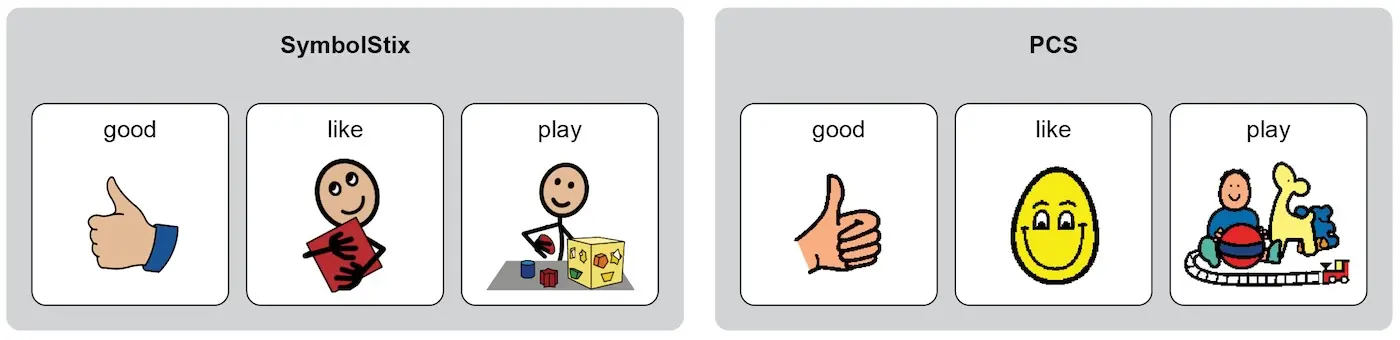
If your learner already uses AAC, consult their speech pathologist, educator or support team about which picture set to choose. In many cases, the picture set used in the books can be matched to the ones the learner sees in their communication system, classroom or therapy setting.
If you are unsure which option to select, don’t worry. Unless a school or learning environment uses one picture set exclusively, the choice between SymbolStix and PCS is generally not critical. Both picture sets are widely recognised and can effectively support language, literacy and communication development. Read about picture symbol systems here.
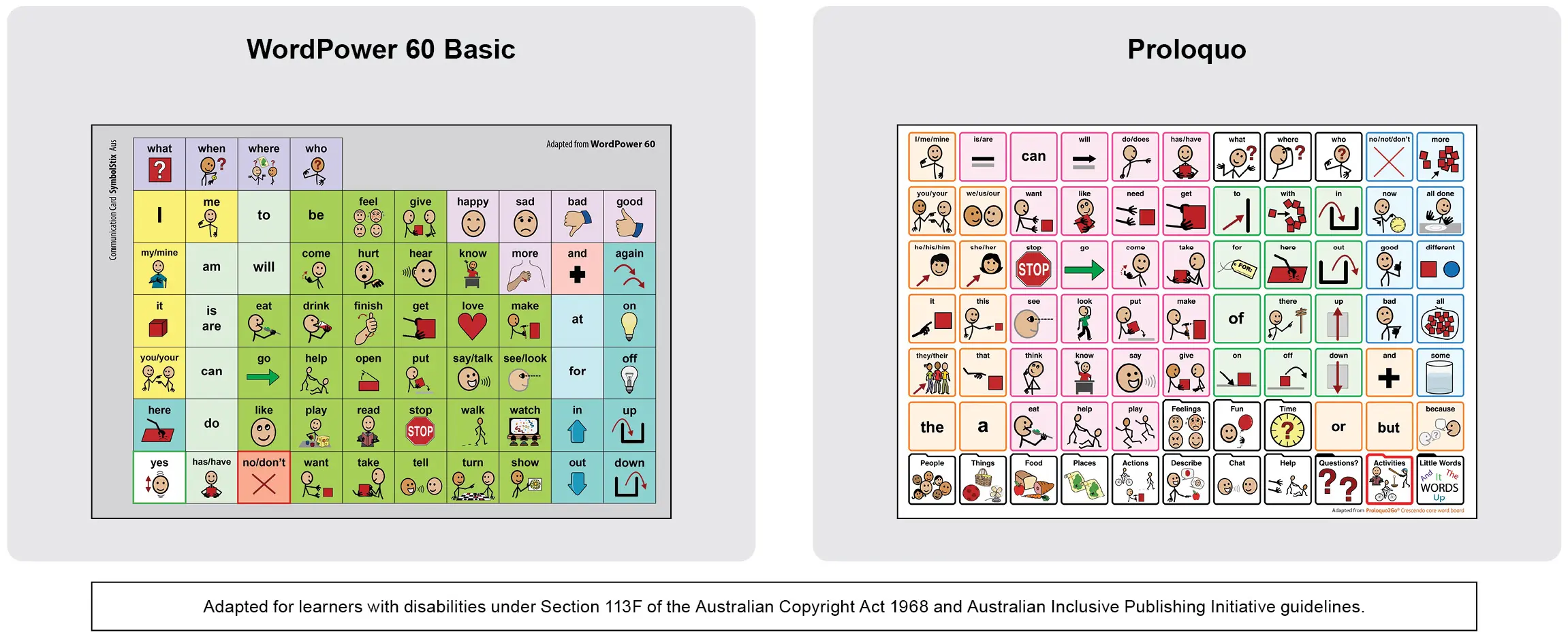
Core Vocabulary Card Styles: There are many commercially available AAC systems and communication apps that use different core vocabulary layouts and organisational approaches. Read Book Clinic currently offers adapted core vocabulary cards based on TouchChat WordPower 60 Basic and Proloquo Core Vocabulary and book navigation cards based on the PODD Communication Book system.
If a learner already uses AAC, choosing a layout that is familiar to the learner may support navigation and language practice.
Read Book Clinic has no affiliation with, or preference for, a particular AAC developer or communication system. We strongly support providing learners with access to a comprehensive/robust language system that allows them to communicate across a wide range of topics, purposes and situations. The core vocabulary cards included with our books may provide an entry point to AAC for some learners and a familiar language support for others who already use AAC. They are designed to support aided language stimulation and shared reading experiences. Below is a visual guide to the Core Vocabulary cards available with your book products.
Customised Readers: Passion focused
Books can also be customised to reflect the learner’s individual interests, making content personally relevant and motivating. These are suited for individuals with diverse learning profiles and provide opportunities to engage with print in ways that resonate with personal preferences, strengths and experiences. Book formats consider potential print trauma, ensuring that the reintroduction of print is handled with sensitivity and attention to the learner’s needs.
PODD Communication Books
The PODD (Pragmatic Organisation Dynamic Display) Communication Book is my ‘go to’ low-tech tool for emergent communicators – it is comprehensive, systematic and customisable. The PODD was initially adapted to optimise single-handed access and address the functional needs of users with reduced finger dexterity. Adaptations come in two tab styles: fully visible and semi-visible. User customisation follows standard PODD practice. The adapted books are suitable for both end users and communication partners, including therapists and educators. For more information on the PODD system, see CPEC – PODD. Formal PODD training is recommended.
Contact me with your enquiry.